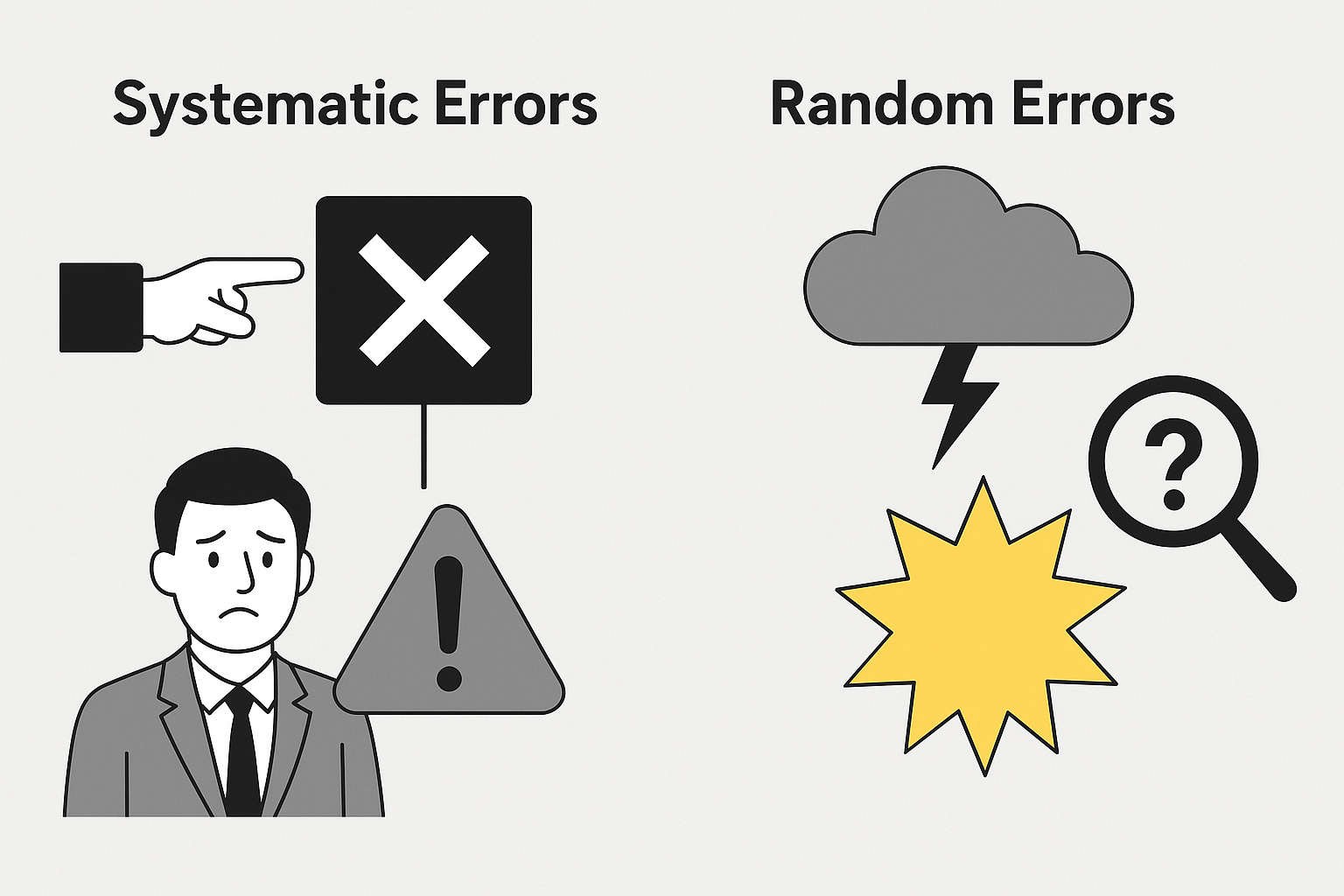
Systematic and Random Failures in Functional Safety
In the world of functional safety, failures are more than just unpleasant surprises — they’re an inevitable part of reality that engineers must learn to live with. Every system, even the best-designed one, can fail. The question is: why? Sometimes it’s chance, sometimes human error, and sometimes an entire process that allowed imperfection to slip through. Understanding the difference between random and systematic failures is the foundation of safety thinking. It’s not about academic definitions, but about turning that understanding into practice that protects health, life, and the reputation of engineers.
Systematic and Random Failures in Functional Safety
In functional safety, failures are not just bad luck — they are an unavoidable part of reality that we must learn to deal with. Every system, no matter how well designed, can fail. The question is: why? Sometimes it’s chance, sometimes human error, and sometimes the process itself that allowed a flaw to remain unnoticed. Understanding the difference between random and systematic failures is fundamental to safety thinking. And it’s not about memorizing definitions, but about applying that knowledge in ways that protect lives, health, and the reputation of engineers.
Two faces of failure: chance and human error
In simple terms, technical systems experience two main types of failures: random and systematic. Both can lead to malfunctions, but their causes are completely different. Random failures are caused by physics and probability — the aging of components, material fatigue, or environmental effects beyond our control. Systematic failures, on the other hand, stem from human decisions: poor assumptions, coding errors, lack of standards, or miscommunication. In short: randomness is unpredictable, but humans can ruin things quite methodically.
Random failures – when hardware simply ages
Random failures appear without pattern or predictability. No one plans for a transistor to burn out at 5:42 p.m. on a Wednesday — that’s just their nature. They occur due to wear of electronic components, temperature, vibration, humidity, or even cosmic radiation flipping a single bit in memory. Every component has a defined lifetime — the time during which it can be expected to operate according to specification. Once it’s exceeded, the probability of failure rises sharply. That’s why home appliances often stop working “just after warranty” — not because someone planned it, but because matter itself wears out.
Example? Think of an electric kettle. After years of daily use, it suddenly stops working because the microswitch in the handle degraded from heat. Or a laptop whose SSD dies after five years. In industry, a pressure sensor might start returning wrong values because its diaphragm has deformed or resistors drifted. It’s not the designer’s fault — it’s just physics doing its thing. In safety systems, such failures can’t be eliminated, but their impact can be mitigated. We use redundancy (two sensors instead of one), periodic tests, self-diagnostics, and statistical reliability models to predict when to replace a component before it fails.
Systematic failures – when humans leave traces
Systematic failures are completely different. They don’t occur because of aging or randomness — they are built into the system from the start. They come from human mistakes, missing procedures, vague requirements, or the classic “we’ve always done it this way.” Such failures often stay hidden for years, until a specific, rare input combination triggers a chain reaction that leads to a malfunction.
Example? Two engineers work on the same software. One uses variables like temperature_sensor_1, the other prefers temp1. Sounds harmless, but in a chemical process control system, that mix-up can send readings to the wrong place. Lack of naming standards and code reviews means the system works fine 99% of the time, until one day — with an unusual data set — it makes the wrong decision. The failure didn’t come from electronics, but from a human oversight months earlier.
Another classic example of a systematic failure is a mismatched interface between modules. Suppose Team A sends data in milliseconds, and Team B assumes it’s in seconds. The result? The system reacts a thousand times too fast or too slow. These errors are especially dangerous because they come not from physical failures, but from miscommunication and assumptions. That’s why standards like ISO 26262 emphasize process, documentation, reviews, and independent testing — because fighting systematic failures requires not an oscilloscope, but a well-organized team.
How do we deal with failures in Functional Safety?
Because random and systematic failures have entirely different causes, the approaches to reducing them must also differ. ISO 26262 separates them clearly: random failures belong to hardware, systematic ones to development processes and software. In practice, one is managed through physics and statistics, the other through engineering discipline.
For random failures, engineers use strategies like redundancy (e.g. 2oo3 architecture – two out of three must agree for a valid decision), integrity testing, periodic sensor checks, and reliability metrics such as MTBF (Mean Time Between Failures). The goal isn’t to prevent failure completely, but to ensure it’s detected and doesn’t lead to a hazardous situation.
Systematic failures require a completely different approach. Sensors and statistics won’t help, because the problem originates from people and processes. That’s why we rely on code reviews, FMEA and FTA analysis, independent testing, tool qualification, change management, and — most importantly — an engineering culture where “we’ve always done it this way” is not an acceptable argument. In reality, most systematic failures can be eliminated early if the design process is methodical and properly supervised.
Why does it matter?
Because functional safety is not just about probabilities — it’s about understanding that every system is a blend of humans and machines. Machines fail randomly; humans fail systematically. Recognizing that difference allows us to build systems resistant to both. That’s why we create detection mechanisms, redundancy, periodic tests, documentation reviews, audits, and team training.
Random failures are like an aging bridge — it eventually breaks if not maintained. Systematic failures are like a poorly designed bridge — it collapses even when new. Both lead to disasters, but only one can be predicted in a spreadsheet. The other requires thinking, skepticism, and humility.
Summary
Understanding random and systematic failures isn’t dry theory — it’s the foundation of designing safe systems. Functional Safety isn’t a set of rules, it’s a way of thinking about risk. Every sensor, every line of code, and every design decision matters, because even the smallest oversight can go unnoticed until the day it causes a failure. It’s not just about making a system work — it’s about making it work safely, even when something goes wrong.